
opencolibri / starter-sales-kit-bundle

Colibri Starter sales kit: Symfony bundle of the demo shop admin (shops, datasets, castor-api runs), built on Sylius Shadcn Admin UI
Package info
github.com/opencolibri/starter-sales-kit-bundle
Type:symfony-bundle
pkg:composer/opencolibri/starter-sales-kit-bundle
Requires
- php: >=8.3
- knplabs/knp-menu-bundle: ^3.0
- opencolibri/starter-core: dev-main
- opencolibri/starter-datasets: dev-main
- opencolibri/starter-themes: dev-main
- pagerfanta/core: ^4.6
- sylius/admin-ui: ^0.14
- sylius/grid-bundle: ^1.13
- sylius/shadcn-admin-ui: ^0.14@dev
- sylius/twig-hooks: ^0.14
- sylius/ui-translations: ^0.14
- symfony/form: ^7.4
- symfony/framework-bundle: ^7.4
- symfony/http-client: ^7.4|^8.0
- symfony/security-bundle: ^7.4
- symfony/ux-live-component: ^2.30 || ^3.5
- symfony/validator: ^7.4
- symfony/yaml: ^7.4|^8.0
Requires (Dev)
- symfony/browser-kit: ^7.4|^8.0
- symfony/css-selector: ^7.4|^8.0
Suggests
None
Provides
None
Conflicts
None
Replaces
None
This package is auto-updated.
Last update: 2026-11-20 19:48:19 UTC
README
The admin of a sales kit: create demo shops from datasets, generate and load their catalog into Sylius, give each one its storefront theme and header layout, keep it private for a customer, and browse the datasets. A Symfony bundle built on Sylius Shadcn Admin UI. Each team builds its own sales kit instance from it: users, branding, colors, domains and extra pages stay in the instance.
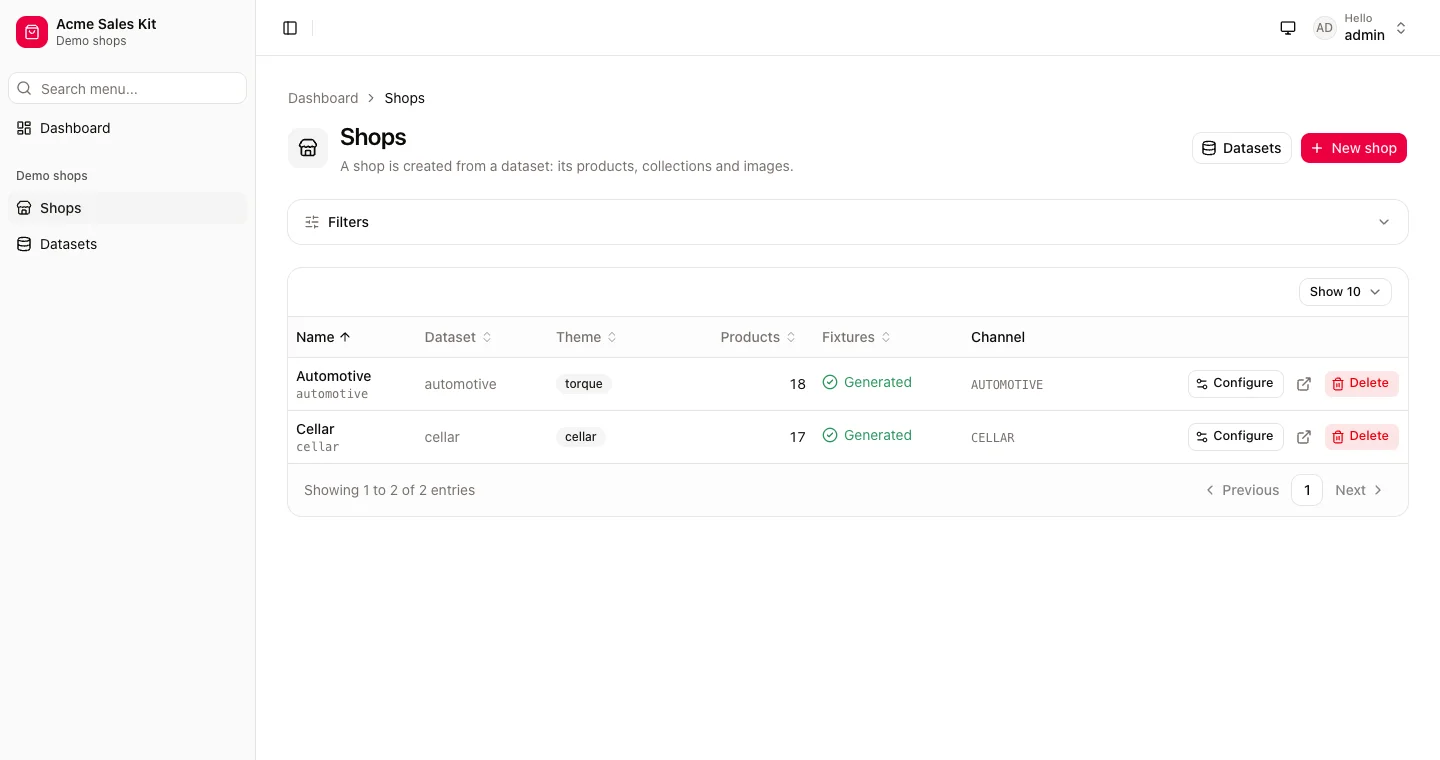
Developed in the colibri-starter monorepo (src/SalesKitBundle), split
into the read-only opencolibri/starter-sales-kit-bundle repository. Unlike
the other packages, it is not a Castor plugin but a Symfony bundle. See the
sales kit section of the documentation for an overview.
How it works
The admin never changes Sylius itself. A sales kit stack runs the shared Sylius app of the demo shops and castor-api, which runs Castor tasks over HTTP; the admin calls it for every action and follows the long ones (generate, load, delete…) with Live components.
sales kit admin (this bundle) ──HTTP──▶ castor-api ──▶ Castor tasks ──▶ shared Sylius app (one channel per shop)
            └──────────── reads and writes the shared .castor/import directories ────────────┘
What the stack provides
| What | Used for |
|---|---|
The sylius:shop:* tasks of opencolibri/starter-sales-kit |
shops (list, create, generate, load, delete, theme, visibility), with a theme, a private storefront and an admin each |
The sylius:dataset:* tasks of opencolibri/starter-fixtures and opencolibri/starter-dataset-builder |
datasets (list, build, images, export, delete) |
sales-kit:theme:list (JSON: themes, and the headers of HeaderLayout::all()), sales-kit:theme:header |
thin #[AsApi] tasks over ThemeBundle::pickable() and sylius:theme:header |
Every theme installed with the theme-bundle target (castor sylius:theme:setup all --target=theme-bundle) |
the theme picker |
The .castor/import/var, .castor/import/exports and .castor/import/datasets directories, mounted in the admin |
shop images and project.yaml, run progress, dataset zips, catalogs of the datasets it built (read only) |
What the package ships
| Part | Where |
|---|---|
| castor-api client, run descriptions | src/Castor/ |
Shop images and project.yaml storage, run progress |
src/Import/ |
| Pages: dashboard figures, shops, datasets and their catalog, theme and dataset thumbnails, Caddy on-demand TLS endpoint | src/Controller/, src/Dataset/, templates/ |
| Shop and dataset lists: PHP Sylius grids, filtered, sorted and paginated in memory | src/Grid/, src/Repository/ |
Live components: SalesKit:RunMonitor, ShopActions, ShopVisibility, ThemePicker, HeaderLayoutPicker, DeleteShop |
src/Twig/Components/ |
Anonymous components: sales_kit:action_button, sales_kit:message, sales_kit:header_preview |
templates/components/ui/ |
| Sidebar items (Dashboard, Shops, Datasets) | src/Menu/AdminMenuBuilder.php (decorates sylius_admin_ui.knp.menu_builder) |
| Hooks of every page, plus the Shadcn Admin UI hooks | config/app.php |
| Tailwind sources of the templates | assets/styles/sales-kit.css |
Login, logout, the layout, the sidebar, the dark mode and the color themes come from Sylius Admin UI and Shadcn Admin
UI. The theme and dataset thumbnails come from opencolibri/starter-themes and opencolibri/starter-datasets.
Install it in an instance
An instance is a Symfony app (AssetMapper, Tailwind) next to a sales kit stack. sylius/shadcn-admin-ui has no
release yet: allow its development version next to the package.
composer require opencolibri/starter-sales-kit-bundle:^0.1@dev sylius/shadcn-admin-ui:^0.14@dev
Flex enables the bundles. Then:
- Hooks of the pages, then your own below the import (they win):
# config/packages/opencolibri_sales_kit.yaml
imports:
    - { resource: '@OpenColibriStarterSalesKitBundle/config/app.php' }

opencolibri_sales_kit: ~
- Routes:
# config/routes/sales_kit.yaml
sylius_admin_ui:          # login, logout, dashboard
    resource: '@SyliusAdminUiBundle/config/routes.php'
opencolibri_sales_kit:    # shops, datasets, thumbnails, Caddy endpoint
    resource: '@OpenColibriStarterSalesKitBundle/config/routes.php'
live_component:
    resource: '@LiveComponentBundle/config/routes.php'
    prefix: '/_components'
- Firewall on the Sylius Admin UI login routes (a recipe cannot merge
security.yaml):# config/packages/security.yaml security: password_hashers: Symfony\Component\Security\Core\User\InMemoryUser: auto providers: admin: memory: users: '%admin_users%' # or any user provider firewalls: main: lazy: true provider: admin form_login: login_path: sylius_admin_ui_login check_path: sylius_admin_ui_login_check default_target_path: sylius_admin_ui_dashboard enable_csrf: true csrf_parameter: _csrf_admin_security_token csrf_token_id: admin_authenticate logout: path: sylius_admin_ui_logout target: sylius_admin_ui_login access_control: - { path: ^/_caddy/on-demand-ask, roles: PUBLIC_ACCESS } - { path: ^/login, roles: PUBLIC_ACCESS } - { path: ^/, roles: ROLE_USER }
- Styles:
assets/styles/admin.css, listed insymfonycasts_tailwind.input_css:@import "tailwindcss"; @import "../../vendor/sylius/shadcn-admin-ui/assets/styles/theme.css"; @import "../../vendor/opencolibri/starter-sales-kit-bundle/assets/styles/sales-kit.css";
- JavaScript: an
adminentrypoint inimportmap.php(./assets/admin.js) that starts Stimulus (import { startStimulusApp } from '@symfony/stimulus-bundle'; startStimulusApp();), with thelivecontroller of@symfony/ux-live-componentenabled inassets/controllers.json. - Environment: see the configuration below, and mount the
.castor/importdirectories of the stack.
Configuration
Every option defaults to an environment variable:
opencolibri_sales_kit:
    castor_api:
        url: '%env(CASTOR_API_URL)%'
        token: '%env(default::CASTOR_API_TOKEN)%'           # empty: no authentication
    shop_root_domain: '%env(SHOP_ROOT_DOMAIN)%'             # shops on {slug}.<domain>
    import_var_dir: '%env(IMPORT_VAR_DIR)%'                 # .castor/import/var of the stack
    import_export_dir: '%env(IMPORT_EXPORT_DIR)%'           # .castor/import/exports of the stack (dataset zips)
    import_datasets_dir: '%env(default::IMPORT_DATASETS_DIR)%'  # .castor/import/datasets, read only: catalogs of the datasets built by the stack
Customizing an instance
- Branding:
sylius_admin.common.component.sidebar.logo,sylius_admin.security.login.page.logoandsylius_admin.base#base_titlehooks. - Colors:
sylius_shadcn_admin_ui.themes(e.g.[stone, rose]), or shadcn tokens inadmin.css. - Blocks on a page: each page renders its own hook plus
opencolibri_sales_kit.common.page. Add a hookable toopencolibri_sales_kit.shop.show.content.body.aside(or.main,.main.storefront,.content.bodyof any page), disable one withenabled: false, or replace its template. The page data is inhookable_metadata.context(see the table below). A context value that is null is left out: read it with|default(null). - Grids:
ShopGridandDatasetGrid(src/Grid/) are PHP Sylius grids (#[AsGrid]), so an instance changes them like any Sylius grid. castor-api returns every shop or dataset in one call: the grid providers turn the criteria, sorting and page into calls onShopRepository/DatasetRepository(immutable in-memory queries:withSearch(),withTheme(),orderBy(),paginate()…), loaded once per request. - Pages: controllers of the instance, and a decorator of
sylius_admin_ui.knp.menu_builderfor the sidebar.
| Page hook | Context |
|---|---|
opencolibri_sales_kit.shop.index |
resources (grid view) |
opencolibri_sales_kit.shop.new |
form, datasets |
opencolibri_sales_kit.shop.show |
shop, projectForm, themes, theme_headers |
opencolibri_sales_kit.dataset.index |
resources (grid view) |
opencolibri_sales_kit.dataset.show |
dataset, catalog (null when its files are not readable), collection, shops |
opencolibri_sales_kit.dataset.new |
form, source |
sylius_admin.dashboard.index |
— |
Tests
vendor/bin/phpunit --testsuite sales-kit # from the monorepo root
tests/Application/Kernel.php is a sales kit instance with an admin user, where castor-api is replaced by
tests/Support/FakeCastorApi.php: the list tasks answer the JSON of tests/Fixtures/castor-api/, every call is
recorded, and fail() / conflict() make a task fail or hold its lock. No sales kit stack is needed. The tests cover
the in-memory repositories, the dataset catalogs, the castor-api client, the pages (WebTestCase) and the Live and
Twig components (InteractsWithLiveComponents, InteractsWithTwigComponents).
Good to know
- Inside a
<twig:…>component,thisis that component and macros imported by the template are not visible: read the data and render the hooks before it. Shared bits are anonymous components (<twig:sales_kit:action_button>,<twig:sales_kit:message>). - Never
{% set icon = ux_icon(...) %}then{{ icon }}:ux_icon()returns a plain string and is only marked safe where it is printed, so the variable is escaped. Print it directly, or capture it with{% set icon %}…{% endset %}(aMarkup, safe everywhere, including inside the blocks of another component). - The admin is in English only for now.