sandermuller / laravel-fluent-validation
Fluent validation rule builders for Laravel
Package info
github.com/SanderMuller/laravel-fluent-validation
pkg:composer/sandermuller/laravel-fluent-validation
Fund package maintenance!
Requires
- php: ^8.2
- illuminate/contracts: ^11.0||^12.0||^13.0
- illuminate/support: ^11.0||^12.0||^13.0
- illuminate/validation: ^11.0||^12.0||^13.0
Requires (Dev)
- driftingly/rector-laravel: ^2.3
- larastan/larastan: ^3.9.3
- laravel/boost: ^2.4.2
- laravel/pint: ^1.29
- livewire/livewire: ^3.0||^4.0
- mrpunyapal/rector-pest: ^0.2.7
- nunomaduro/collision: ^8.0
- orchestra/testbench: ^9.0||^10.11
- pestphp/pest: ^3.0||^4.4.5
- pestphp/pest-plugin-arch: ^3.0||^4.0
- pestphp/pest-plugin-laravel: ^3.0||^4.1
- phpstan/extension-installer: ^1.4.3
- phpstan/phpstan-deprecation-rules: ^2.0.4
- phpstan/phpstan-phpunit: ^2.0.16
- phpstan/phpstan-strict-rules: ^2.0.10
- rector/rector: ^2.4.1
- rector/type-perfect: ^2.1.2
- sandermuller/package-boost: ^0.9.0
- spaze/phpstan-disallowed-calls: ^4.10
- symplify/phpstan-extensions: ^12.0.2
- tomasvotruba/cognitive-complexity: ^1.1
- tomasvotruba/type-coverage: ^2.1
Suggests
- nikic/php-parser: ^5.0 — required by SanderMuller\FluentValidation\Testing\Arch\BansFieldRuleTypeMethods, an opt-in Pest/PHPUnit arch helper that bans type-specific method calls on the untyped FluentRule::field() builder.
- dev-main
- 1.25.0
- 1.24.0
- 1.23.0
- 1.22.0
- 1.21.0
- 1.20.0
- 1.19.0
- 1.18.0
- 1.17.1
- 1.17.0
- 1.16.0
- 1.15.1
- 1.15.0
- 1.14.0
- 1.13.2
- 1.13.1
- 1.13.0
- 1.12.3
- 1.12.2
- 1.12.1
- 1.12.0
- 1.11.0
- 1.10.0
- 1.9.2
- 1.9.1
- 1.9.0
- 1.8.2
- 1.8.1
- 1.8.0
- 1.7.1
- 1.7.0
- 1.6.0
- 1.5.0
- 1.4.1
- 1.4.0
- 1.3.0
- 1.2.0
- 1.1.0
- 1.0.1
- 1.0.0
- 0.5.3
- 0.5.2
- 0.5.1
- 0.5.0
- 0.4.5
- 0.4.4
- 0.4.3
- 0.4.2
- 0.4.1
- 0.4.0
- 0.3.6
- 0.3.5
- 0.3.4
- 0.3.3
- 0.3.2
- 0.3.1
- 0.3.0
- 0.2.4
- 0.2.3
- 0.2.2
- 0.2.1
- 0.2.0
- 0.1.3
- 0.1.2
- 0.1.1
- 0.1.0
This package is auto-updated.
Last update: 2026-04-29 15:23:42 UTC
README
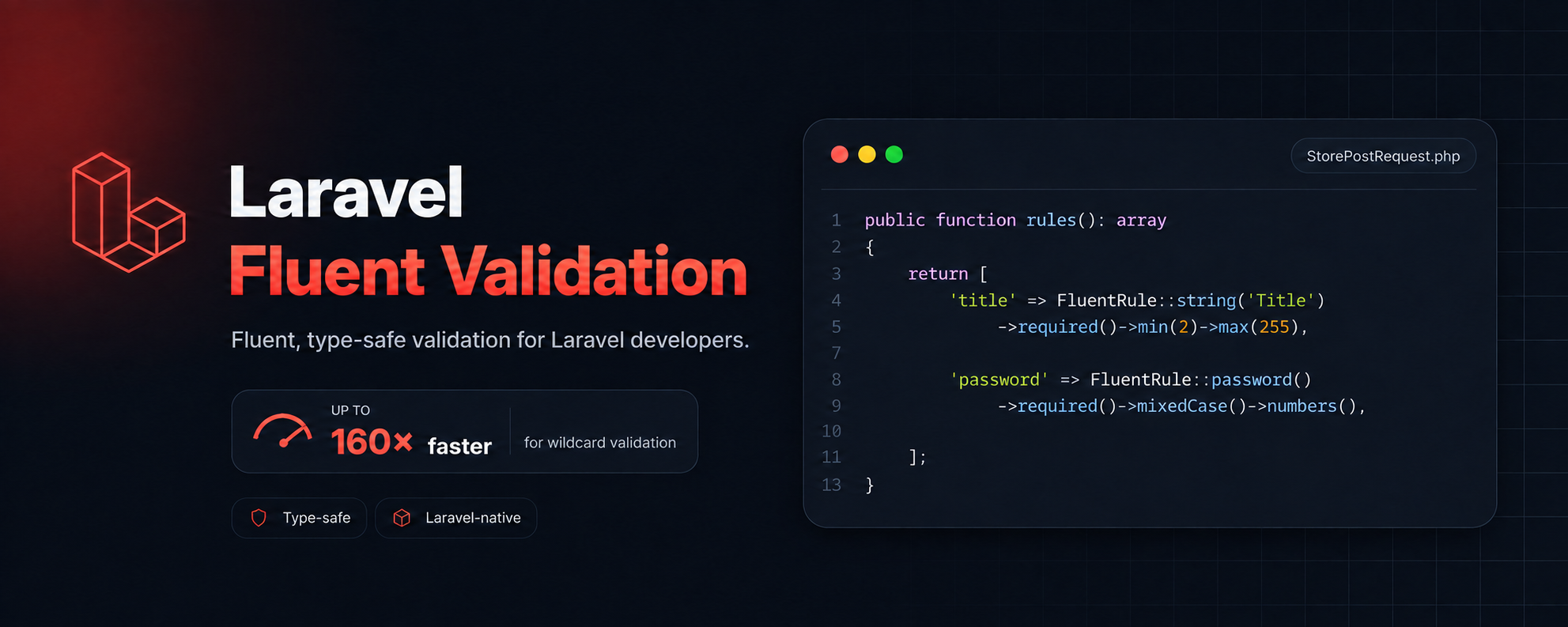
Write Laravel validation rules with IDE autocompletion instead of memorizing string syntax. Each rule type exposes only the methods that apply to it: FluentRule::string() won't offer digits(), FluentRule::date() won't offer mimes(). each() and children() keep parent and child rules in one place instead of scattered across dot-notation keys. For large arrays, the HasFluentRules trait makes wildcard validation up to 160x faster.
// Before 'name' => 'required|string|min:2|max:255', 'email' => ['required', 'email', Rule::unique('users')->ignore($id)], 'role' => Rule::when($isAdmin, 'required|string|in:admin,editor'), 'items' => 'array', 'items.*.id' => 'required|integer|exists:items,id', 'items.*.name' => 'required|string|max:255', // After 'name' => FluentRule::string('Full Name')->required()->min(2)->max(255), 'email' => FluentRule::email('Email')->required()->unique('users', 'email', fn ($r) => $r->ignore($id)), 'role' => FluentRule::string()->when($isAdmin, fn ($r) => $r->required()->in(['admin', 'editor'])), 'items' => FluentRule::array()->each([ 'id' => FluentRule::integer()->required()->exists('items', 'id'), 'name' => FluentRule::string()->required()->max(255), ]),
Migrating an existing codebase? Jump straight to Migrating existing validation with Rector; a companion package automates the bulk of the rewrite.
Contents
Getting started
- Why this package?: DX, type safety, structure, performance, and how it compares to Laravel's
Ruleclass - Installation
- Usage: Form Requests, migrating existing rules, extending parent rules, other contexts
- Error messages: labels, per-rule messages
- Array validation: each, children, nesting
Migration
- Migrating existing validation with Rector: automated rewrite via companion Rector package
- Common migration patterns: detailed reference for manual conversions (external doc)
Static analysis
- Static analysis with PHPStan: opt-in PHPStan rules package that flags unbounded
each()chains
Deep dive
- Livewire: HasFluentValidation trait, Filament workaround
- Performance: O(n) wildcards, pre-evaluation, fast-check closures, batched DB, benchmarks
- RuleSet: builder, conditional fields, custom Validators
- Testing:
FluentRulesTester, Pest expectations - Rule reference: all types, modifiers, conditionals, macros
- Troubleshooting: common issues and solutions
Why this package?
Fluent
If you've ever wondered whether min:5 means characters, an integer, array elements, or kilobytes (it depends on the type rule next to it), forgotten which slot in unique:users,email,$ignoreId,id holds the ignored ID, or had to look up whether to use date_equals, same, or before_or_equal to compare two dates, you know the frustration. The IDE answers that for you now. Each type has its own class, so FluentRule::string() won't even offer digits(), and FluentRule::date() won't offer mimes().
Array notation
each() and children() group parent and child rules in one place instead of scattering them across 20 flat dot-notation keys. Wildcard children land under their parent definition; fixed-key children stay scoped to the field they belong to. Nested arrays nest naturally. The flat 'items.*.name' form still works when you want it.
Messages & attributes
Labels and per-rule messages attach to the rule itself, so there's no separate messages() or attributes() array to drift out of sync with rules(). FluentRule::email('Email Address')->required(message: 'We need your :attribute.') carries both the human-readable name and the failure copy with the rule definition.
Performance
Where you'll actually feel this is on endpoints that validate a lot of fields or a lot of items at once: CSV/JSON imports, bulk-edit forms, settings pages, anything with wildcard arrays like items.*.id or orders.*.line_items.*.product_id. On a 3-field login form FluentRule is still faster than the native pipeline, but you won't notice; the saving is in microseconds.
Laravel's wildcard validation is O(n²) on large arrays; HasFluentRules rewrites the expansion as a single tree walk and makes it up to 160x faster for nested wildcards, 62x faster for conditional-heavy payloads. Database exists/unique checks against wildcard arrays batch into a single whereIn query instead of one per item. Common rules compile to PHP closures that bypass Laravel's validator entirely on the happy path.
Compared to Laravel's Rule class
FluentRule is intentionally named differently from Illuminate\Validation\Rule so both can be used without aliasing. You generally don't need Laravel's Rule at all.
Type starters
Laravel's Rule |
FluentRule equivalent |
|---|---|
Rule::string() |
FluentRule::string() |
Rule::numeric() |
FluentRule::numeric() / FluentRule::integer() |
Rule::date() |
FluentRule::date() |
Rule::dateTime() |
FluentRule::dateTime() |
Rule::email() |
FluentRule::email() |
Rule::file() |
FluentRule::file() |
Rule::imageFile($allowSvg) |
FluentRule::image()->allowSvg() (or just image()) |
Rule::array($keys = null) |
FluentRule::array($keys) |
Rule::dimensions([...]) |
FluentRule::image()->minWidth(...)->ratio(...) |
Set membership and value spaces
Laravel's Rule |
FluentRule equivalent |
|---|---|
Rule::in([...]) |
->in([...]) (on any typed builder) |
Rule::notIn([...]) |
->notIn([...]) |
Rule::contains([...]) |
FluentRule::array()->contains(...) |
Rule::doesntContain([...]) |
FluentRule::array()->doesntContain(...) |
Rule::enum(Status::class) |
FluentRule::enum(Status::class) / ->enum(...) |
Rule::anyOf([...]) |
FluentRule::anyOf([...]) |
Database lookups
Laravel's Rule |
FluentRule equivalent |
|---|---|
Rule::unique('users')->where(...) |
->unique('users', 'col', fn ($r) => $r->where(...)) |
Rule::exists('roles')->where(...) |
->exists('roles', 'col', fn ($r) => $r->where(...)) |
Conditional callables
Laravel's Rule |
FluentRule equivalent |
|---|---|
Rule::when($cond, $rules, $default) |
->when($cond, fn ($r) => …, fn ($r) => …) |
Rule::unless($cond, $rules, $default) |
->when(! $cond, …) |
Rule::requiredIf(fn () => …) |
->requiredIf(fn () => …) |
Rule::requiredUnless(fn () => …) |
->requiredUnless(fn () => …) |
Rule::excludeIf(fn () => …) |
->excludeIf(fn () => …) |
Rule::excludeUnless(fn () => …) |
->excludeUnless(fn () => …) |
Rule::prohibitedIf(fn () => …) |
->prohibitedIf(fn () => …) |
Rule::prohibitedUnless(fn () => …) |
->prohibitedUnless(fn () => …) |
Iteration
Laravel's Rule |
FluentRule equivalent |
|---|---|
Rule::forEach(fn ($v, $k) => …) |
FluentRule::array()->each(FluentRule::string()->…) |
Authorization (escape hatch only)
Laravel's Rule |
FluentRule equivalent |
|---|---|
Rule::can('ability', …$args) |
->rule(['can', 'ability', …$args]) |
FluentRule additions with no Laravel equivalent
| Method | What it does |
|---|---|
->each([key => FluentRule, …]) |
Co-locate wildcard child rules |
->children([key => FluentRule, …]) |
Co-locate fixed-key child rules |
->label('Full Name') |
Replaces :attribute in messages |
->message('…') / ->messageFor('…', '…') |
Per-rule custom messages |
->fieldMessage('…') |
Field-level fallback message |
->whenInput(fn ($input) => …) |
Branch on full input at validation time |
Installation
You can install the package via composer:
composer require sandermuller/laravel-fluent-validation
Requires PHP 8.2+ and Laravel 11+.
AI-assisted development
If you use Laravel Boost, this package ships with skills that give AI assistants the full FluentRule API reference:
php artisan boost:install # adds the skills php artisan boost:update # publishes updates after package upgrades
Usage
In a form request
Add the HasFluentRules trait to your form request:
use Illuminate\Foundation\Http\FormRequest; use SanderMuller\FluentValidation\FluentRule; use SanderMuller\FluentValidation\HasFluentRules; class StorePostRequest extends FormRequest { use HasFluentRules; public function rules(): array { return [ 'title' => FluentRule::string('Title')->required()->min(2)->max(255), 'body' => FluentRule::string()->required(), 'email' => FluentRule::email('Email')->required()->unique('users'), 'date' => FluentRule::date('Publish Date')->required()->afterToday(), 'agree' => FluentRule::accepted(), 'avatar' => FluentRule::image()->nullable()->max('2mb'), 'tags' => FluentRule::array(label: 'Tags')->required()->each( FluentRule::string()->max(50) ), 'password' => FluentRule::password()->required()->mixedCase()->numbers(), ]; } }
The label 'Title' replaces :attribute in error messages. You get "The Title field is required" instead of "The title field is required", without a separate attributes() array.
Or extend FluentFormRequest instead of adding the trait manually:
use SanderMuller\FluentValidation\FluentFormRequest; class StorePostRequest extends FluentFormRequest { public function rules(): array { /* same as above */ } }
Note
FluentRule is a static factory, not a base class. FluentRule::string() returns a StringRule, FluentRule::email() returns an EmailRule, etc. For PHPDoc type hints, reference FluentRuleContract (see below) or Laravel's ValidationRule, not FluentRule itself.
Typing your rules() return
Every shipped rule class implements SanderMuller\FluentValidation\Contracts\FluentRuleContract, a single stable type alias covering the full shared modifier and conditional surface. Use it instead of enumerating concrete types:
use SanderMuller\FluentValidation\Contracts\FluentRuleContract; /** @return array<string, FluentRuleContract> */ public function rules(): array { return [ 'name' => FluentRule::string()->required()->min(2), 'email' => FluentRule::email()->required()->unique('users'), 'age' => FluentRule::numeric()->nullable()->integer()->min(0), ]; }
FluentRuleContract extends Illuminate\Contracts\Validation\ValidationRule, so downstream code already typed against Laravel's native contract keeps working. Type-specific methods (e.g. StringRule::email(), NumericRule::integer(), ImageRule::dimensions()) stay on their concrete classes. Narrow to the concrete type when you need to call them.
Migrating existing rules
You don't need to convert all your rules at once. Fluent rules mix freely with string rules and native rule objects in the same array:
$rules = [ 'name' => FluentRule::string()->required()->min(2)->max(255), // fluent 'email' => 'required|string|email|max:255', // string, still works 'role' => ['required', LaravelRule::in(['admin', 'user'])], // array, still works ];
Step 1: Add use HasFluentRules to your form request. This works even before you convert any rules.
Step 2: Convert fields. Either by hand (start with the ones that benefit most from autocompletion: complex conditionals, date comparisons, nested arrays), or run the Rector companion to migrate the bulk of your rules in one pass and review the diff. Common conversions if you're going manually:
| Before | After |
|---|---|
'items.*.name' => 'required|string' |
FluentRule::array()->each(['name' => FluentRule::string()->required()]) |
'search' => 'array' and 'search.value' => '...' |
FluentRule::array()->children(['value' => ...]) |
Rule::in([...]) |
->in([...]) or ->in(MyEnum::class) |
Rule::unique('users') |
->unique('users') |
Rule::forEach(fn () => ...) |
FluentRule::array()->each(...) |
All conditional methods (requiredIf, excludeUnless, etc.) accept Closure|bool in addition to field references. each() and children() nest naturally. Flat dot-notation keys like columns.*.data.sort become nested each([...children([...])]) trees that mirror the data shape.
Tip
Using Boost? If you have Laravel Boost installed, ask your AI assistant to run the fluent-validation-optimize skill. It scans your codebase for convertible rules, prioritizes by impact, and applies changes file by file.
Step 3: For rules without a direct fluent method, use the rule() escape hatch:
FluentRule::string()->rule('email:rfc,dns') // string rule FluentRule::string()->rule(new MyCustomRule()) // object rule FluentRule::file()->rule(['mimetypes', ...$types]) // array tuple
Extending parent rules in child form requests
To add fields in a child, use the spread operator: return [...parent::rules(), 'extra' => FluentRule::string()->required()]. If you need to modify a parent's rule, clone it first since ->rule() mutates the object: $rules['type'] = (clone $rules['type'])->rule(new ExtraRule()).
When the parent defines a keyed each([...]) or children([...]) map and the child needs to add or replace one sub-rule, use the extend helpers on ArrayRule / FieldRule via RuleSet::modify, or reach for the modifyEach / modifyChildren sugar:
// Parent return RuleSet::from([ 'answers' => FluentRule::array()->nullable()->max(20)->each([ 'text' => FluentRule::string()->required(), ]), ]); // Child, sugar form (later-wins merge) return parent::rules()->modifyEach('answers', [ 'id' => FluentRule::numeric()->nullable(), ]); // Or the strict-add primitive; throws on existing-key collision return parent::rules()->modify('answers', fn (ArrayRule $rule) => $rule->addEachRule('id', FluentRule::numeric()->nullable()) );
modifyEach wraps mergeEachRules (later-wins on collision); modifyChildren wraps mergeChildRules on FieldRule. For strict add-only semantics, use the primitive modify(..., fn ($r) => $r->addEachRule(...)). addEachRule / addChildRule throw on existing-key collision. Base constraints (nullable, max:20, etc.) are preserved by design.
rules() may also return a RuleSet directly; HasFluentRules (and HasFluentValidation for Livewire) auto-unwrap it via ->toArray() before passing to the validator. This lets you chain ->only/->except/->merge/->put/->get and return without a terminal ->toArray() call:
// Assumes a class-level helper that returns a RuleSet, e.g. // class UserRules { public static function base(): RuleSet { return RuleSet::from([...]); } } public function rules(): RuleSet { return UserRules::base() ->only(['email', 'password']) ->put('email_confirmation', FluentRule::email()->required()->same('email')); }
RuleSet also implements IteratorAggregate, so spread works on it too: [...$ruleSet, 'extra' => FluentRule::string()->required()].
Other contexts
For Livewire components, use the HasFluentValidation trait. For inline validation outside form requests, use RuleSet::validate(). For custom Validator subclasses, extend FluentValidator.
FluentRule objects implement Laravel's ValidationRule interface, so they also work directly in $request->validate(), Validator::make(), Rule::forEach(), and Rule::when():
use SanderMuller\FluentValidation\FluentRule; $validated = $request->validate([ 'name' => FluentRule::string()->required()->min(2)->max(255), 'email' => FluentRule::email()->required(), 'age' => FluentRule::numeric()->nullable()->integer()->min(0), ]);
In these direct-call contexts FluentRule objects self-validate in isolation: labels don't reach the outer validator and the four optimizations don't engage. Reach for the trait or RuleSet::validate() for production code.
Error messages
Labels
Pass a label as the first argument to any factory method. It replaces :attribute in error messages for that field:
use Illuminate\Foundation\Http\FormRequest; use SanderMuller\FluentValidation\FluentRule; use SanderMuller\FluentValidation\HasFluentRules; class StorePostRequest extends FormRequest { use HasFluentRules; public function rules(): array { return [ 'name' => FluentRule::string('Full Name')->required()->min(2)->max(255), 'email' => FluentRule::email('Email Address')->required(), 'age' => FluentRule::integer('Your Age')->nullable()->min(0), 'items' => FluentRule::array(label: 'Import Items')->required()->min(1), ]; // "The Full Name field is required." // "The Email Address field must be a valid email address." // "The Import Items field must have at least 1 items." } }
Labels also work inside each(), so child fields get clean names:
'items' => FluentRule::array()->required()->each([ 'name' => FluentRule::string('Item Name')->required(), 'email' => FluentRule::email('Email')->required(), ]), // "The Item Name field is required." (instead of "The items.0.name field is required.")
You can also set a label after construction with ->label('Name').
Caution
Labels only reach the validator through one of the four pathways below. With bare $request->validate() or Validator::make(), FluentRule objects self-validate in isolation and the label is dropped, so you'll see Laravel's default :attribute (the snake-cased field name) in error messages instead.
| Context | Use |
|---|---|
| FormRequest | HasFluentRules |
| Inline / anywhere | RuleSet::validate() |
| Livewire | HasFluentValidation |
| Custom validator | FluentValidator |
Per-rule messages
The recommended form is the inline message: named argument, which attaches the message directly to the rule it applies to:
FluentRule::string('Full Name') // Sets the label, used in the message as :attribute ->required(message: 'We need your :attribute!') // Translates to "We need your Full Name!" ->min(2, message: ':attribute has to be least :min characters.') // Translates to "Full Name has to be at least 2 characters." ->max(255)
Inline message: is available on the factory itself (e.g. FluentRule::email(message: 'Invalid email.')) and on every non-variadic rule method.
Three forms exist; each has a use case:
| Form | When to use |
|---|---|
->method(…, message: '…') |
Recommended. Colocated with the rule, rename-safe, works on factories and rule methods. Unavailable on variadic-trailing methods (see below). |
->method(…)->message('…') |
Shorthand when you want the message on the most recent rule. Binds to $lastConstraint. Works on variadic methods too (->requiredWith('a', 'b')->message('…')). |
->messageFor('rule', '…') |
Targets a rule by name at any point in the chain. Use when you need to message a non-last sub-rule on composite methods (e.g. integer under ->digits(…)), or a Macroable method PHPStan/IDE can't see. |
// Variadic method: message: cannot follow a variadic param. Use ->message() (shorter) or messageFor(). FluentRule::string()->requiredWith('email', 'phone')->message('Required when email or phone is set.') // Composite method (->digits adds `integer` then `digits:N`). message: binds to the LAST sub-rule. FluentRule::numeric()->digits(5, message: ':attribute must be 5 digits.') ->messageFor('integer', ':attribute must be a whole number.') // Custom rule object: message: on ->rule() binds to the object's class-basename key. FluentRule::string()->rule(new MyRule(), message: 'Custom failure.')
For a field-level fallback that applies to any failure, use ->fieldMessage():
FluentRule::string()->required()->min(2)->fieldMessage('Something is wrong with this field.')
Note
Standard Laravel messages() arrays and Validator::make() message arguments still work and take priority over message:, ->message(), ->messageFor(), and ->fieldMessage(). When Laravel emits multiple rule keys for a single fluent factory (e.g. FluentRule::email()->when(..., fn ($r) => $r->required()) produces required + string + email), each distinct message still belongs in messages(); inline message: only carries one binding per call.
Array validation with each() and children()
each() |
children() |
|
|---|---|---|
| Data shape | Array of items ([{...}, {...}, ...]) |
Single object with known keys ({key: ...}) |
| Produces | Wildcard paths (items.*.name) |
Fixed paths (search.value) |
| Use when | You have a list of N items with the same structure | You have one object with specific sub-keys |
To validate each item in an array, use the each() method:
// Scalar items: each tag must be a string under 255 characters FluentRule::array()->each(FluentRule::string()->max(255)) // Object items: each item has named fields FluentRule::array()->required()->each([ 'name' => FluentRule::string('Item Name')->required(), 'email' => FluentRule::email()->required(), 'qty' => FluentRule::numeric()->required()->integer()->min(1), ]) // Nested arrays FluentRule::array()->each([ 'items' => FluentRule::array()->each([ 'qty' => FluentRule::numeric()->required()->min(1), ]), ])
each() works standalone and through Form Requests with HasFluentRules. The trait and RuleSet both optimize wildcard expansion.
Tip
Catch unbounded each() at analyse time. The companion PHPStan package flags each() chains without a size cap (->max(), ->between(), ->exactly(), or a key whitelist). That's the shape that turns into an N+1 / DoS footgun with ->exists() or closure rules on large payloads.
Fixed-key children with children()
When validating an object with known keys (not a wildcard array), you may use children() to keep child rules with their parent:
// Instead of: 'search' => FluentRule::array()->required(), 'search.value' => FluentRule::string()->nullable(), 'search.regex' => FluentRule::string()->nullable()->in(['true', 'false']), // Write: 'search' => FluentRule::array()->required()->children([ 'value' => FluentRule::string()->nullable(), 'regex' => FluentRule::string()->nullable()->in(['true', 'false']), ]),
children() produces fixed paths (search.value), while each() produces wildcard paths (items.*.name). children() is also available on FluentRule::field() for untyped fields with known sub-keys.
Combining each() and children()
Both may be used together on the same array. This example validates a datatable with columns that have nested search and render options:
'columns' => FluentRule::array()->required()->each([ 'data' => FluentRule::field()->nullable() ->rule(FluentRule::anyOf([FluentRule::string(), FluentRule::array()])) ->children([ 'sort' => FluentRule::string()->nullable(), 'render' => FluentRule::array()->nullable()->children([ 'display' => FluentRule::string()->nullable(), ]), ]), 'search' => FluentRule::array()->required()->children([ 'value' => FluentRule::string()->nullable(), ]), ]),
The rule tree mirrors the data shape. Compare this with the flat dot-notation alternative: columns.*.data, columns.*.data.sort, columns.*.data.render.display, columns.*.search.value, each defined separately.
Tip
Using Boost?
The fluent-validation-optimize skill automatically detects flat dot-notation keys that can be grouped with each() and children(), and converts them for you.
Livewire
Add the HasFluentValidation trait to Livewire components. It compiles FluentRule objects before Livewire's validator sees them:
use Livewire\Component; use SanderMuller\FluentValidation\FluentRule; use SanderMuller\FluentValidation\HasFluentValidation; class EditUser extends Component { use HasFluentValidation; public string $name = ''; public string $email = ''; public function rules(): array { return [ 'name' => FluentRule::string('Name')->required()->max(255), 'email' => FluentRule::email('Email')->required(), ]; } public function save(): void { $validated = $this->validate(); // ... } }
The trait provides full Livewire support. Labels, messages, each(), children(), wire:model.blur real-time validation, Form objects, and $rules properties all work automatically.
// both styles work in Livewire components: // flat wildcard keys 'items' => FluentRule::array()->required(), 'items.*.name' => FluentRule::string()->required(), // each(): the trait expands this for Livewire automatically 'items' => FluentRule::array()->required()->each([ 'name' => FluentRule::string()->required(), ]),
Filament components: HasFluentValidation conflicts with Filament's InteractsWithForms (v3/v4) / InteractsWithSchemas (v5) because both define validate(), validateOnly(), getRules(), and getValidationAttributes(). Use HasFluentValidationForFilament instead. The Rector companion picks it plus the required insteadof block whenever InteractsWithForms / InteractsWithSchemas is used on a class, every run. FluentRule compilation, label/message extraction, each()/children() expansion, Filament's form-validation-error event dispatch, and form-schema rule aggregation all keep working.
Manual setup (if you're not running the Rector companion)
use Filament\Forms\Concerns\InteractsWithForms; use SanderMuller\FluentValidation\HasFluentValidationForFilament; class EditUser extends Component implements HasForms { use HasFluentValidationForFilament, InteractsWithForms { HasFluentValidationForFilament::validate insteadof InteractsWithForms; HasFluentValidationForFilament::validateOnly insteadof InteractsWithForms; HasFluentValidationForFilament::getRules insteadof InteractsWithForms; HasFluentValidationForFilament::getValidationAttributes insteadof InteractsWithForms; } }
Livewire + Laravel Boost
If you use Laravel Boost, the fluent-validation-livewire skill covers trait usage, Filament workarounds, and common mistakes automatically.
Performance
The win is real for endpoints that validate a lot of fields or a lot of items at once: CSV/JSON ingest, bulk-edit, settings pages, anywhere a single request hits wildcard arrays like items.*.id or orders.*.line_items.*.product_id. On a 3-field login form FluentRule is still faster than native, but you won't notice; the saving is in microseconds.
When you use one of the optimized entry points (HasFluentRules on a FormRequest, HasFluentValidation on a Livewire component, FluentValidator, or RuleSet::validate()), FluentRule objects compile down to native Laravel format before validation runs and pick up four extra optimizations:
- O(n) wildcard expansion: replaces Laravel's O(n²)
Arr::dot()+ regex expansion with a single tree walk - Pre-evaluation of conditional rules: resolves
exclude_unless/exclude_ifbefore validation and removes excluded attributes from the rule set - Fast-check closures: compiles 30+ common rules into PHP closures that skip Laravel's validator entirely for passing values
- Batched database validation: turns N
exists/uniquequeries into a singlewhereIn
Benchmarks
| Scenario | Optimizations | Native Laravel | Optimized | Speedup |
|---|---|---|---|---|
| Product import, 500 items, simple rules | Wildcard, fast-check | ~163ms | ~3ms | ~62x |
| Nested order lines, 1000 orders × 5 line items | Wildcard, fast-check (nested) | ~2,491ms | ~15ms | ~163x |
| Conditional import, 100 items, 47 conditional fields | Wildcard, pre-evaluation | ~2,928ms | ~47ms | ~62x |
| Event scheduling, 100 items, field-ref dates | Wildcard, fast-check (field-ref dates) | ~19ms | ~0.7ms | ~28x |
| Article submission, 50 items, custom Rule objects | Wildcard only | ~8ms | ~2ms | ~3x |
| Login form, 3 fields, no wildcards | Fast-check (flat) | ~0.1ms | ~0.02ms | ~7x |
All numbers are from php benchmark.php (macOS, PHP 8.4, OPcache); CI runs produce the same scenarios on Ubuntu.
O(n) wildcard expansion
Laravel's explodeWildcardRules() flattens data with Arr::dot() and matches regex patterns against every key. For each wildcard rule, it scans every key in the flattened array, making the expansion O(n²). The package replaces this with a tree traversal that walks the data once and emits concrete paths as it descends.
Pre-evaluation of conditional rules
Rules like exclude_unless and exclude_if are evaluated before the validator starts. Excluded attributes are removed from the rule set entirely, so the validator only sees the rules that actually apply. For a payload with 100 items and 47 conditional fields, this reduces the rule set from ~4,700 to ~200.
Fast-check closures
The package compiles 30+ common rules into PHP closures that bypass Laravel's validator when values pass. Coverage:
- Type checks:
string,numeric,email,date,array,boolean,in,regex - Presence gates:
required,prohibited - Date / size / equality comparisons: literal dates plus wildcard-sibling references (
after:start_date,gte:min_price,same:password,confirmed) - Presence-conditional:
required_with,required_without,required_with_all,required_without_all - Value-conditional:
required_if,required_unless,prohibited_if,prohibited_unless
The two conditional families are pre-evaluated per item against the current row's data: rewritten to bare required/prohibited when active, or dropped when inactive, so the remainder of the chain fast-checks normally. Dotted dependent paths (required_without:profile.birthdate, required_if:profile.role,admin) are resolved via data_get against the item during reduction.
What the closure does is simpler than what Laravel does. A string|max:255 rule becomes is_string($v) && strlen($v) <= 255. No rule parsing, no method dispatch, no BigNumber size comparison. Values that pass never touch the validator. Values that fail fall through to Laravel so the error message stays identical, with no custom-formatting layer to maintain.
Rules that can't be fast-checked (custom Rule objects, closures, distinct, exists/unique with closure callbacks) go through Laravel as normal.
Fast-checks apply to both wildcard rules (items.*.name) and flat top-level rules. A simple RuleSet::from(['name' => 'string|max:255'])->validate($data) skips Laravel's validator entirely when the value passes.
Batched database validation
When wildcard arrays use exists or unique rules, Laravel fires one database query per item. 500 items means 500 queries. HasFluentRules and RuleSet::validate() batch these into a single whereIn query automatically.
Rules with scalar where() clauses are batched too. Rules with closure callbacks fall through to per-item validation. Batching is transparent: error messages, custom messages, and validated() output are unchanged.
DB batching impact depends on driver and network latency; it is measured in the test suite (--group=benchmark) rather than in benchmark.php.
Guards against hostile input. Because values are batched from raw input before per-item rules run, batching is protected by three layered safeguards so a 100k-element POST body cannot trigger a hundred whereIn queries or crash a strict database:
- Parent
max:Nis honoured. If the parent array is declaredmax:100but the request sends 1_000 items, batching short-circuits before any query runs, and you see a normalValidationExceptionon the parent attribute. Only the immediate parent'smax:Nis inspected (notsize:N,between:a,b, or outer ancestors in nested-wildcard chains). The check also assumes numerically-indexed wildcards (items.0.id,orders.0.items.0.id); if your API accepts string-keyed collections ({"items": {"foo": {...}}}), rely on the hard cap below for defence-in-depth. - Per-item type rules filter the batch.
integer,numeric,uuid,ulid,stringrules on each item drop values that couldn't pass validation anyway, so malformed input like{"id": "abc"}never reaches a PostgreSQLINTEGERcolumn (which would otherwise raiseinvalid input syntax for type integer). End-user error semantics are unchanged; the per-item rule still reports the error. - Hard cap.
BatchDatabaseChecker::$maxValuesPerGroup(default10_000) is a defence-in-depth ceiling per(table, column, rule-type)group. Exceeding it throwsSanderMuller\FluentValidation\Exceptions\BatchLimitExceededException, which the trait andRuleSet::validate()/check()remap to the standardValidationException. Override once during boot if your legitimate bulk-import endpoints need more headroom:
// app/Providers/AppServiceProvider.php use SanderMuller\FluentValidation\BatchDatabaseChecker; public function boot(): void { BatchDatabaseChecker::$maxValuesPerGroup = 50_000; }
Power users who want to handle parent-max and hard-cap differently (e.g. map to HTTP 413) can catch BatchLimitExceededException before the remap; it carries $reason, $ruleType, $valueCount, $limit, and $attribute for routing decisions.
RuleSet::validate()
For inline validation outside form requests, RuleSet::validate() applies the same optimizations:
$validated = RuleSet::from([ 'items' => FluentRule::array()->required()->each([ 'name' => FluentRule::string('Item Name')->required()->min(2), 'qty' => FluentRule::numeric()->required()->integer()->min(1), ]), ])->validate($request->all());
Benchmarks run automatically on PRs via GitHub Actions. All optimizations are Octane-safe (factory resolver restored via try/finally, no static state leakage).
Benchmark scenarios
Product import
500 products with simple, fully fast-checkable rules. All fields pass through PHP closures without touching Laravel's validator.
'products' => FluentRule::array()->required()->each([ 'sku' => FluentRule::string()->required()->max(50)->regex('/^SKU-/'), 'name' => FluentRule::string()->required()->min(2)->max(255), 'price' => FluentRule::numeric()->required()->min(0), 'quantity' => FluentRule::numeric()->required()->integer()->min(0), 'category' => FluentRule::string()->required()->in(['electronics', 'clothing', 'food']), 'active' => FluentRule::boolean()->required(), 'tags' => FluentRule::string()->nullable()->max(50), ]),
Optimizations: O(n) wildcard expansion + fast-check closures for all fields.
Nested order lines
1000 orders, each with 5 line items. Nested wildcards (orders.*.line_items.*.product_id) are expanded within the per-item closure.
'orders' => FluentRule::array()->required()->each([ 'order_number' => FluentRule::string()->required()->alphaDash()->min(5), 'status' => FluentRule::string()->required()->in(['pending', 'processing', 'shipped']), 'line_items' => FluentRule::array()->required()->each([ 'product_id' => FluentRule::numeric()->required()->integer(), 'quantity' => FluentRule::numeric()->required()->integer()->min(1), 'price' => FluentRule::numeric()->required()->min(0.01), ]), ]),
Optimizations: O(n) wildcard expansion + fast-check closures, including the nested level.
Conditional import
100 interactive media items with 47 wildcard patterns. Most fields use exclude_unless to conditionally apply rules based on the item's type field. Only ~4 fields apply per item type out of 47 total.
// String rules work through the same optimization path as FluentRule objects. 'interactions' => 'required|array|min:1', 'interactions.*.type' => ['required', 'string', Rule::in([...])], 'interactions.*.title' => ['nullable', 'string'], 'interactions.*.start_time' => ['required', 'numeric', 'min:0'], 'interactions.*.end_time' => ['required', 'numeric', 'gte:interactions.*.start_time'], // Only validated when type = 'chapter': 'interactions.*.should_start_collapsed' => [['exclude_unless', 'interactions.*.type', 'chapter'], 'boolean'], 'interactions.*.should_collapse_after_menu_item_click' => [['exclude_unless', 'interactions.*.type', 'chapter'], 'boolean'], // Only validated when type = 'chapter' or 'menu': 'interactions.*.position' => ['bail', ['exclude_unless', 'interactions.*.type', 'chapter', 'menu'], 'string'], // ... 40+ more conditional fields across 9 interaction types
Optimizations: O(n) wildcard expansion + pre-evaluation removes ~95% of rules before validation starts.
Event scheduling
100 events with date fields. Both literal date comparisons and wildcard-sibling field references fast-check.
'events' => FluentRule::array()->required()->each([ 'name' => FluentRule::string()->required()->min(3)->max(255), 'start_date' => FluentRule::date()->required()->after('2025-01-01'), // literal → fast-checked 'end_date' => FluentRule::date()->required()->after('start_date'), // field ref → fast-checked 'registration_deadline' => FluentRule::date()->required()->before('start_date'), // field ref → fast-checked ]),
Optimizations: O(n) wildcard expansion + fast-check for every field. Sibling field references (after:start_date, before:start_date) resolve against the current wildcard item at call time via a second closure variant, so date comparisons don't fall through to Laravel.
Article submission
50 articles where most rules are custom ValidationRule objects. Custom objects bypass fast-check compilation entirely, so only the wildcard expansion helps.
'articles' => FluentRule::array()->required()->each([ 'title' => FluentRule::string()->required()->min(3)->max(255), 'slug' => FluentRule::string()->required()->alphaDash()->max(255), 'content' => ['required', 'string', new MinimumWordCount(100)], 'category' => ['required', new ValidCategory()], 'priority' => ['required', new ValidPriority()], ]),
Optimizations: O(n) wildcard expansion only. Custom Rule objects bypass fast-check compilation, so most fields go through Laravel's validator.
Login form
3 fields, no wildcards. All three rules are fully fast-checkable, so RuleSet::validate() skips Laravel's validator entirely when values pass.
'email' => FluentRule::email()->required()->max(255), 'password' => FluentRule::string()->required()->min(8), 'remember' => FluentRule::boolean()->nullable(),
Optimizations: Fast-check closures for all three fields. Absolute savings are small (~0.1ms → ~0.02ms), but the relative speedup is ~6x since a simple form doesn't give Laravel much wildcard work to amortize against.
When this won't help
The performance optimizations target wildcard array validation. These cases see little or no speedup:
gt/gte/lt/ltewithout a type flag. Laravel derives comparison type from an accompanying rule (string/array/numeric/integer). Without one, these fall through to Laravel. With a type flag, sibling-field comparisons likenumeric|gt:min_priceare fast-checked.date_format+ date field-ref. Laravel parses both sides with the declared format and has lenient missing-ref handling our strtotime-based closure can't match. Falls through to Laravel.- Multi-param
different:a,b,c. Single-fielddifferent:ais fast-checked; comma-list forms fall through. - Custom
ValidationRuleobjects and closures. Opaque to the fast-check compiler. Performance depends on what the rule does. distinctrules. Require comparing values across all items in the array, not per-item.- Database rules with closure callbacks (
exists/uniquewith->where(fn ...)). Can't be batched; each item fires its own query.
If you're not sure whether validation is your bottleneck, profile first. Laravel Telescope shows total request time breakdowns.
Tip
Using Boost?
The fluent-validation-optimize skill finds form requests with wildcard rules that are missing HasFluentRules, prioritizes them by impact, and adds the trait automatically.
RuleSet
For validation outside of form requests, you may use RuleSet to build, merge, and validate rule sets:
use SanderMuller\FluentValidation\RuleSet; // From an array $validated = RuleSet::from([ 'name' => FluentRule::string('Full Name')->required()->min(2)->max(255), 'items' => FluentRule::array()->required()->each([ 'name' => FluentRule::string()->required()->min(2), 'price' => FluentRule::numeric()->required()->min(0), ]), 'role' => FluentRule::string()->when($isAdmin, fn ($r) => $r->required()->in(['admin', 'editor'])), 'permissions' => FluentRule::array()->when($isAdmin, fn ($r) => $r->required()), ]) ->merge($sharedAddressRules) ->validate($request->all()); // Or fluently, with conditional fields and merging $validated = RuleSet::make() ->field('name', FluentRule::string('Full Name')->required()) ->field('items', FluentRule::array()->required()->each([ 'name' => FluentRule::string()->required()->min(2), 'price' => FluentRule::numeric()->required()->min(0), ])) ->when($isAdmin, fn (RuleSet $set) => $set ->field('role', FluentRule::string()->required()->in(['admin', 'editor'])) ->field('permissions', FluentRule::array()->required()) ) ->merge($sharedAddressRules) ->validate($request->all());
when() and unless() are available via Laravel's Conditionable trait. merge() accepts another RuleSet or a plain array.
| Method | Returns | Description |
|---|---|---|
RuleSet::from([...]) |
RuleSet |
Create from a rules array |
RuleSet::make()->field(...) |
RuleSet |
Fluent builder |
->merge($ruleSet) |
RuleSet |
Merge another RuleSet or array into this one |
->only(...$fields) |
RuleSet |
Keep only the named fields (variadic strings or single array) |
->except(...$fields) |
RuleSet |
Drop the named fields (variadic strings or single array) |
->put($field, $rule) |
RuleSet |
Add or replace a single field's rule |
->get($field, $default = null) |
mixed |
Read a single field's rule (uncompiled), or $default if absent |
->modify($field, fn ($rule)) |
RuleSet |
Read-modify-write a single field; clones before callback; throws on missing key |
->all() |
array |
Collection-style alias of ->toArray() |
[...$ruleSet] |
array |
Spread support via IteratorAggregate; yields $this->toArray() shape |
->when($cond, $callback) |
RuleSet |
Conditionally add fields (also: unless) |
->toArray() |
array |
Flat rules with each() expanded to wildcards |
->validate($data) |
array |
Validate with full optimization (see Performance) |
->check($data) |
Validated |
Validate without throwing. See errors-as-data |
->prepare($data) |
PreparedRules |
Expand, extract metadata, compile. For custom Validators |
->expandWildcards($data) |
array |
Pre-expand wildcards without validating |
RuleSet::compile($rules) |
array |
Compile fluent rules to native Laravel format |
RuleSet::compileToArrays($rules) |
array |
Compile to array format for Livewire's $this->validate() |
->failOnUnknownFields() |
RuleSet |
Reject input keys not present in the rule set |
->stopOnFirstFailure() |
RuleSet |
Stop validating after the first field fails |
->dump() |
array |
Returns {rules, messages, attributes} for debugging |
->dd() |
never |
Dumps and terminates |
Errors-as-data with check()
validate() throws ValidationException on failure. For import pipelines, batch jobs, and any flow where exceptions are the wrong control structure, use check() instead. It returns an immutable Validated object:
use SanderMuller\FluentValidation\RuleSet; foreach ($rows as $row) { $result = RuleSet::from($rules)->check($row); if ($result->fails()) { Log::warning('row rejected', $result->errors()->all()); continue; } $safe = $result->safe(); // Illuminate\Support\ValidatedInput, gives you ->only(), ->except(), ->collect() $array = $result->validated(); // plain array (throws if the result failed) insert_row($safe->all()); }
| Method | Returns | Description |
|---|---|---|
->passes() |
bool |
Did validation pass? |
->fails() |
bool |
Inverse of passes() |
->errors() |
MessageBag |
All validation errors (empty bag on success) |
->firstError($field) |
?string |
First error message for a field, or null |
->validated() |
array |
Validated data; throws ValidationException if it failed |
->safe() |
ValidatedInput |
Same data as validated(), wrapped for ->only()/->except()/->collect() access |
->validator() |
ValidatorContract |
Escape hatch for deep Laravel integration (->after(), ->sometimes(), extensions) |
check() runs the same internal engine as validate() (fast-check closures, wildcard expansion, batched DB queries). There is no double-parse; the result object just wraps the outcome.
Rejecting unknown fields
failOnUnknownFields() rejects input keys that don't match any rule in the set. If someone sends role when you only defined name and email, validation fails:
$validated = RuleSet::from([ 'name' => FluentRule::string()->required(), 'email' => FluentRule::email()->required(), ])->failOnUnknownFields()->validate($request->all()); // Input: ['name' => 'John', 'email' => 'john@example.com', 'role' => 'admin'] // → ValidationException: "The role field is prohibited."
Wildcard arrays are checked too. items.0.hack fails if only items.*.name is defined. You can customize the error message per field:
->validate($data, messages: ['role.prohibited' => 'This field is not allowed.']);
Tip
For form requests, Laravel 13.4+ has a native #[FailOnUnknownFields] attribute that works automatically with HasFluentRules.
Stopping on first failure
stopOnFirstFailure() bails after the first field error. If the file upload fails, the 500 exists queries for items never run:
$validated = RuleSet::from([ 'file' => FluentRule::file()->required()->max('10mb'), 'items' => FluentRule::array()->required()->each([ 'sku' => FluentRule::string()->required()->exists('products', 'sku'), ]), ])->stopOnFirstFailure()->validate($request->all());
The same applies inside wildcard arrays. If the first item fails, the rest are skipped.
Named error bags (withBag)
Multiple forms on one page (Fortify's update-password + reset-password, a Livewire multi-card screen, etc.) need separate error bags so their validation messages don't collide. Chain ->withBag($name) on the rule set; the thrown ValidationException's errorBag is set to that name:
RuleSet::from([ 'current_password' => FluentRule::string()->required()->currentPassword(), 'password' => FluentRule::string()->required()->min(12), ]) ->withBag('updatePassword') ->validate($input);
Mirrors Laravel's Validator::validateWithBag() without forcing you back to the Validator::make(...) incantation. Only affects the thrown exception's bag; check() never throws and is unaffected.
Using with a raw Validator instance
If you still need to touch the Validator directly (inspection, non-standard extensions), prepare() gives you the compiled pieces:
$prepared = RuleSet::from($rules)->prepare($request->all()); $validator = Validator::make( $request->all(), $prepared->rules, array_merge($prepared->messages, $customMessages), $prepared->attributes, ); $validator->validate();
Using with custom Validators
If your application extends Illuminate\Validation\Validator directly (for example, in import jobs), you may extend FluentValidator instead:
use SanderMuller\FluentValidation\FluentValidator; class JsonImportValidator extends FluentValidator { public function __construct(array $data, protected ?User $user = null) { parent::__construct($data, $this->buildRules()); } private function buildRules(): array { return [ '*.type' => FluentRule::string()->required()->in(InteractionType::cases()), '*.end_time' => FluentRule::numeric() ->requiredUnless('*.type', ...InteractionType::withoutDuration()) ->greaterThanOrEqualTo('*.start_time'), ]; } }
FluentValidator resolves the translator and presence verifier from the container, calls prepare() on the rules, and sets implicit attributes. Cross-field wildcard references (requiredUnless('*.type', ...)) work automatically.
Migrating rules in a non-standard method? If your custom Validator holds its rules in a method that isn't named rules() (for example rulesWithoutPrefix() for a JSON-import pipeline), mark the method with #[SanderMuller\FluentValidation\FluentRules] so the migration Rector rules detect it. The attribute has no runtime effect; see the #[FluentRules] opt-in docs for the full semantics and guard interactions.
Testing
SanderMuller\FluentValidation\Testing\FluentRulesTester lets you write direct unit tests against fluent rules, RuleSets, FluentFormRequest subclasses, and FluentValidator subclasses without standing up the HTTP kernel or Livewire harness. It's the package's stable test surface; everything else under Testing\ is @internal.
In this section: Targets · Assertions · FormRequest binding · Livewire components · Pest expectations
Targets
FluentRulesTester::for($target) accepts any of these. Chain ->with($data) before assertions (required; calling assertions sooner raises LogicException). with() is re-callable so one tester can validate multiple payloads.
use SanderMuller\FluentValidation\Testing\FluentRulesTester; // 1. Array of rules FluentRulesTester::for(['email' => FluentRule::email()->required()]) ->with(['email' => 'a@b.test'])->passes(); // 2. RuleSet instance FluentRulesTester::for(RuleSet::make()->field('name', FluentRule::string()->required())) ->with(['name' => 'Ada'])->passes(); // 3. A single FluentRule (wrapped under the "value" key) FluentRulesTester::for(FluentRule::string()->required()->min(3)) ->with(['value' => 'hi'])->fails(); // 4. FormRequest class-string, full pipeline including authorize() FluentRulesTester::for(UpdateVideoRequest::class) ->withRoute(['video' => $video])->actingAs($user) ->with(['title' => 'Updated'])->passes(); // 5. FluentValidator class-string; variadic args after for(...) forward to the constructor FluentRulesTester::for(JsonImportValidator::class, $user, 'sku-') ->with($payload)->passes(); // 6. Livewire Component class-string; routes through Livewire::test() so the submit() flow runs FluentRulesTester::for(AppealPage::class) ->set('type', 'refund')->call('submit')->passes();
Assertions
| Method | Purpose |
|---|---|
->passes() |
No errors on any field |
->fails() |
At least one error |
->failsWith($field, $rule = null) |
Field failed. Optional rule key normalized via Str::studly (required and Required both match) |
->failsWithMessage($field, $translationKey, $replacements) |
Rendered translation matches. Use when porting tests that compare against __() output. Pass :attribute explicitly when rules use labels |
->failsOnly($field, $rule = null) |
Exactly one field failed; surgical regression detection. Wildcard error keys expand (items.0.name); requires exactly one matching key |
->failsWithAny($prefix) |
Prefix matched exactly or any dotted descendant (actions.0.payload → also matches actions.0.payload.stars). Not a substring match |
->doesNotFailOn(...$fields) |
Named fields did not fail. Chain after ->fails()/->passes() if overall pass/fail matters; doesNotFailOn alone does not assert either direction |
->assertUnauthorized() |
FormRequest authorize() returned false. The tester records the AuthorizationException rather than rethrowing; surface it via ->fails()->assertUnauthorized() |
Escape hatches: ->errors() returns MessageBag; ->validated() returns the validated array (throws ValidationException on failure).
FormRequest binding
FluentRulesTester::for(UpdateVideoRequest::class) ->withRoute(['video' => $video]) // $this->route('video') returns $video ->actingAs($user) // $this->user() / auth()->user() ->with(['title' => 'New title']) ->passes();
Both withRoute() and actingAs($user, $guard = null) are re-callable (later calls fully replace earlier). actingAs mirrors Laravel's test helper and sets the user on the auth guard before validateResolved() runs.
Livewire components
Two shapes. Pick the one matching what you're asserting:
| Shape | When to use | Target |
|---|---|---|
| Rules-only | Assert rules() has the right shape against a payload. Component lifecycle irrelevant |
for($component->rules()) or for($ruleSet) |
| Component-flow | Drive wire:model state, dispatch an action, assert validation fires (or addError branches, guards, multi-step flows) |
for(ComponentClass::class)->set(...)->call(...) |
The class-string target auto-detects Livewire Component subclasses and routes through Livewire::test(), so the full submit() flow runs: guard clauses, addError() branches, computed state, rate-limit gates. Both $this->validate() failures and manual addError() calls surface via failsWith().
FluentRulesTester::for(EditAppealPage::class) ->mount(['appeal' => $appeal]) // for components with mount() params ->set('type', 'refund') // or set([...]) for multiple keys ->set('reason', 'Order arrived damaged.') ->call('submit') // required before any assertion ->passes();
with([...]) expands to set($key, $value) per pair on Livewire targets. For multi-action chains where action 1 mutates state that action 2 validates against, queue both with ->call(...)->andCall(...); state persists across one Livewire::test() instance, then clears on the next chain:
FluentRulesTester::for(ImportInteractionsModal::class) ->set('video', $targetVideo) ->call('selectVideo', $sourceVideo->uuid) ->andCall('import') ->failsWith('selectedInteractionIds', 'required');
livewire/livewire is a soft dev dep; the Livewire branch class_exists-guards on \Livewire\Component. PHPUnit-only suites see the standard "unsupported target" LogicException rather than a hard fatal.
Edge cases and advanced patterns
Re-callable with() on one tester:
$tester = FluentRulesTester::for($rules); $tester->with(['qty' => 5])->passes(); $tester->with(['qty' => 0])->fails();
failsWithMessage() with labels. When rules use labels, the validator pre-substitutes :attribute into the stored message, so pass it explicitly for the comparison to match:
FluentRulesTester::for([ 'password' => FluentRule::password('Password')->required()->min(8), ]) ->with(['password' => 'short']) ->failsWithMessage('password', 'validation.min.string', [ 'attribute' => 'Password', 'min' => 8, ]);
withRoute() default semantics. Inside the FormRequest:
$this->route('video')returns the bound$video$this->route('video', $default)returns$video(default ignored when key present)$this->route('missing', $default)returns$default
Pre-validate vs post-validate addError. Both surface via failsWith(). A rate-limit guard that returns before validate() runs, and a quota check that runs after a successful validate(), both land in the bag:
// Pre-validate guard. Returns before validate() ever runs. FluentRulesTester::for(AppealPage::class) ->set('rateLimited', true) ->call('submit') ->failsWith('reason'); // Post-validate addError. validate() passes, then addError. FluentRulesTester::for(AppealPage::class) ->set('type', 'refund') ->set('reason', 'Long enough reason.') ->set('quotaExceeded', true) ->call('submit') ->failsWith('type');
State lifecycle on Livewire testers. After one ->call(...) chain resolves, the accumulated with() / set() / call() state clears. Each new chain starts from a fresh Livewire::test() instance, so reused testers don't leak prior cycles into new ones.
Choosing Livewire target shape. Don't reach for the class-string target just because the rules live in a Livewire component. Use it only when the submit() flow (guards, addError, computed state) matters to the test; otherwise stay on the array or RuleSet target with ->with().
Pest expectations (optional)
// tests/Pest.php require_once __DIR__ . '/../vendor/sandermuller/laravel-fluent-validation/src/Testing/PestExpectations.php';
expect($rules)->toPassWith(['email' => 'a@b.test']); expect($rules)->toFailOn(['email' => ''], 'email', 'required'); expect(FluentRule::string()->required())->toBeFluentRuleOf(StringRule::class);
The file class_exists-guards on Pest\Expectation, so requiring it under PHPUnit-only suites is safe.
Rule reference
Available types: FluentRule::string(), integer(), numeric(), email(), password(), date(), dateTime(), boolean(), array(), file(), image(), field(), anyOf(). Shortcuts: url(), uuid(), ulid(), ip().
String: length, pattern, format, comparison
// Length FluentRule::string()->min(2)->max(255) // also: between(2, 255), exactly(10) // Character classes (pick one — each is a complete pattern) FluentRule::string()->alpha() // letters only; also: alphaDash(), alphaNumeric(); each accepts ascii: true FluentRule::string()->ascii() // 7-bit ASCII // Pattern matching FluentRule::string()->regex('/^SKU-\d+$/') // also: notRegex('/\s/') // Affixes FluentRule::string()->startsWith('prefix_')->endsWith('.txt') // also: doesntStartWith(), doesntEndWith() // Case (mutually exclusive — pick one) FluentRule::string()->lowercase() // or: uppercase() // Formats (pick the one that matches your field) FluentRule::string()->url() // also: activeUrl(), uuid(), ulid(), json(), ip(), // ipv4(), ipv6(), macAddress(), timezone(), hexColor() FluentRule::string()->encoding('UTF-8') // Cross-field & confirmation FluentRule::string()->confirmed() // pairs with `<field>_confirmation` FluentRule::string()->currentPassword() // matches the authed user's password; accepts a guard FluentRule::string()->same('confirm_field') // also: different('other_field') // Wildcards & uniqueness in arrays FluentRule::string()->inArray('values.*') // also: inArrayKeys('values.*') FluentRule::string()->distinct() // for `'tags.*'` rules; also: distinct('strict'), distinct('ignore_case')
[!TIP] Top-level shortcuts for the most common single-rule strings:
FluentRule::url(),uuid(),ulid(),ip(),ipv4(),ipv6(),macAddress(),json(),timezone(),hexColor(),activeUrl(),regex($pattern). All accept an optional$label. Each isFluentRule::string()->X(); use the shortcut when the string type is the only constraint beyond the format.
Email: app defaults, modes, uniqueness
FluentRule::email() uses your app's Email::default() configuration when set. Pass defaults: false for basic validation:
FluentRule::email()->required() // uses Email::default() if configured FluentRule::email(defaults: false)->required() // basic 'email' validation FluentRule::email()->rfcCompliant()->strict() // explicit modes override defaults FluentRule::email()->validateMxRecord()->preventSpoofing() FluentRule::email()->required()->unique('users', 'email')
[!TIP]
FluentRule::string()->email()is also available if you prefer keeping email as a string modifier.
Password: strength, confirmation, defaults
FluentRule::password(min: 12)->letters()->mixedCase()->numbers()->symbols()->uncompromised() FluentRule::password()->min(10)->max(64) // length bounds FluentRule::password()->uncompromised(threshold: 3) // allow up to N HIBP hits FluentRule::password()->confirmed() // requires `password_confirmation` field FluentRule::password()->confirmed('Passwords do not match.') // custom mismatch message
FluentRule::password() uses your app's Password::default() configuration (set via Password::defaults() in AppServiceProvider). Pass defaults: false for a plain Password::min(8): FluentRule::password(defaults: false).
Numeric / Integer: type, size, digits, comparison
// Type FluentRule::integer()->required()->min(0) // shorthand for numeric()->integer() FluentRule::integer(strict: true)->required() // reject numeric strings ("42"); requires Laravel 12.23+ FluentRule::numeric()->required() // any numeric value (int or float) // Decimal precision FluentRule::numeric()->decimal(2) // exactly 2 decimal places (e.g. money) FluentRule::numeric()->decimal(0, 2) // up to 2 decimal places // Size & multiples FluentRule::numeric()->min(0)->max(100) // also: between(0, 100), exactly(42) FluentRule::numeric()->multipleOf(5) // Digit-count constraints (pick one) FluentRule::integer()->digits(4) // exactly 4 digits, e.g. PIN, ZIP FluentRule::integer()->digitsBetween(4, 6) // also: minDigits(3), maxDigits(8) // Cross-field comparisons FluentRule::numeric()->greaterThan('min_price')->lessThan('max_price') // also: greaterThanOrEqualTo(), lessThanOrEqualTo() // Sign helpers FluentRule::numeric()->positive() // gt:0, same as greaterThan(0); also: negative() for lt:0 FluentRule::numeric()->nonNegative() // gte:0 (allows zero); also: nonPositive() for lte:0
Date: boundaries, shortcuts, format
All comparison methods accept DateTimeInterface|string:
// Boundary comparisons FluentRule::date()->after('today')->before('2025-12-31') // also: afterOrEqual(), beforeOrEqual() FluentRule::date()->between('2025-01-01', '2025-12-31') // also: betweenOrEqual() // Today-relative shortcuts (mutually exclusive — pick one) FluentRule::date()->afterToday() // also: beforeToday(), todayOrAfter(), todayOrBefore() FluentRule::date()->future() // also: past(), nowOrFuture(), nowOrPast() // Format & equality FluentRule::date()->format('Y-m-d')->dateEquals('2025-06-15') FluentRule::dateTime()->afterToday() // shortcut for date()->format('Y-m-d H:i:s') // Cross-field FluentRule::date()->same('start_date') // also: different('other_field')
Boolean, Array, File, Image, Field, AnyOf
Boolean. boolean() accepts true, false, 1, 0, '1', '0'. Use accepted() for 'yes', 'on', '1', true and declined() for 'no', 'off', '0', false:
FluentRule::boolean()->required() // strict boolean FluentRule::boolean()->acceptedIf('role', 'admin') // also: declinedIf('type', 'free')
Accepted / Declined. Standalone factories for the permissive accepted/declined families without a strict boolean base. Useful for terms-of-service / opt-in checkboxes where form posts deliver 'yes' or 'on' values that Laravel's boolean rule rejects:
FluentRule::accepted() // true | 1 | '1' | 'yes' | 'on' | 'true' FluentRule::accepted()->acceptedIf('role', 'admin') FluentRule::declined() // false | 0 | '0' | 'no' | 'off' | 'false' FluentRule::declined()->declinedIf('under_18', 'yes')
Footgun:
FluentRule::boolean()->accepted()compiles toboolean|accepted;booleanrejects'yes'/'on'whichacceptedwould otherwise permit. UseFluentRule::accepted()(or::declined()) when the input shape is HTML-form-ish.
Array. Size, structure, allowed keys:
// Size FluentRule::array()->min(1)->max(10) // also: between(1, 5), exactly(3) // Shape FluentRule::list() // shortcut for array()->list(), sequentially-indexed FluentRule::array(['name', 'email']) // restrict allowed keys FluentRule::array(MyEnum::cases()) // BackedEnum keys FluentRule::array()->requiredArrayKeys('name', 'email') // Element membership FluentRule::array()->contains('required_value') // also: doesntContain('forbidden_value') FluentRule::array()->distinct() // unique elements; also: distinct('strict'), distinct('ignore_case')
File. Size methods accept integers (kilobytes) or human-readable strings:
// Size FluentRule::file()->max('5mb') // also: min('100kb'), between('1mb', '10mb'), exactly('2mb') // Type (pick the check that matches your trust model) FluentRule::file()->extensions('pdf', 'docx') // by filename extension only FluentRule::file()->mimes('jpg', 'png') // by mime guessed via extension FluentRule::file()->mimetypes('application/pdf') // by actual mime sniffed from contents
Image. Dimension constraints, inherits all file methods:
// Size & format FluentRule::image()->max('5mb')->allowSvg() // Dimension bounds FluentRule::image()->minWidth(100)->maxWidth(1920)->minHeight(100)->maxHeight(1080) // Exact dimensions OR aspect ratio (mutually exclusive — pick one) FluentRule::image()->width(800)->height(600) FluentRule::image()->ratio(16 / 9) // also: ratio('16/9'), ratio(1) for square
Field (untyped). Modifiers without a type constraint. Use field() when the input has no inherent type (e.g. a value that could be a string OR integer depending on context), or when your only validation is modifiers (required, nullable, in, conditional presence). It's also the escape hatch Rector reaches for when it can't narrow the type from pipe/array rules. If you see FluentRule::field() in migrated code, consider whether a typed factory (string(), integer()) better expresses intent.
FluentRule::field()->present() FluentRule::field()->requiredIf('type', 'special') FluentRule::field('Answer')->nullable()->in(['yes', 'no'])
AnyOf. Value passes if it matches any rule set (Laravel 13+):
FluentRule::anyOf([ FluentRule::string()->required()->min(2), FluentRule::numeric()->required()->integer(), ])
Embedded rules: in, unique, exists, enum
String, numeric, and date rules support in, unique, exists, and enum. in() and notIn() accept arrays or a BackedEnum class:
FluentRule::string()->in(['draft', 'published']) FluentRule::string()->in(StatusEnum::class) // all enum values FluentRule::string()->notIn(DeprecatedStatus::class) FluentRule::string()->enum(StatusEnum::class) FluentRule::string()->enum(StatusEnum::class, fn ($r) => $r->only(StatusEnum::Active)) FluentRule::enum(StatusEnum::class) // top-level shortcut, returns an untyped FieldRule FluentRule::string()->unique('users', 'email') FluentRule::string()->unique('users', 'email', fn ($r) => $r->ignore($this->user()->id)) FluentRule::string()->exists('roles', 'name') FluentRule::string()->exists('subjects', 'id', fn ($r) => $r->where('active', true))
unique(), exists(), and enum() accept an optional callback as the last argument. The callback receives the underlying Laravel rule object, so you can chain ->where(), ->ignore(), ->only(), etc.
Field modifiers: presence, prohibition, exclusion, messages
Shared by all rule types:
// Presence ->required() ->nullable() ->sometimes() ->filled() ->present() ->missing() // Conditional presence: accepts field references or Closure|bool. // Value args on *If / *Unless accept BackedEnum, so ->requiredIf('role', Role::Admin) works; no ->value needed. ->requiredIf('role', 'admin') ->requiredUnless('type', 'guest') ->requiredIf(fn () => $cond) ->requiredWith('field') ->requiredWithAll('a', 'b') ->requiredWithout('field') ->requiredWithoutAll('a', 'b') ->requiredIfAccepted('terms') ->requiredIfDeclined('terms') ->presentIf('type', 'admin') ->presentUnless('type', 'guest') ->presentWith('field') ->presentWithAll('a', 'b') // Prohibition & exclusion ->prohibited() ->prohibitedIf('field', 'val') ->prohibitedUnless('field', 'val') ->prohibits('other') ->prohibitedIfAccepted('terms') ->prohibitedIfDeclined('terms') ->exclude() ->excludeIf('field', 'val') ->excludeUnless('field', 'val') ->excludeWith('f') ->excludeWithout('f') // Messages ->label('Name') // sets :attribute for this field's messages ->required(message: 'Please enter your :attribute') // custom message for this rule ->requiredIf('type', 'admin', message: 'Admins must provide :attribute') // custom message for this conditional rule // Debugging ->toArray() ->dump() ->dd() // Other ->bail() ->rule($stringOrObjectOrArray) ->whenInput($condition, $then, $else?)
[!IMPORTANT] To exclude a field from
validated()output, placeexcludealongside the fluent rule:'field' => ['exclude', FluentRule::string()]. Using->exclude()on the FluentRule itself only works within the rule's self-validation scope.
Conditional rules, escape hatch, macros
Conditional rules. All rule types use Laravel's Conditionable trait. A single form request can handle both create and update:
// Required on create, optional on update FluentRule::string()->when($this->isMethod('POST'), fn ($r) => $r->required(), fn ($r) => $r->sometimes()) // Admin-only constraint FluentRule::string()->required()->when($isAdmin, fn ($r) => $r->min(12))->max(255)
For conditions that depend on the input data at validation time, use whenInput():
FluentRule::string()->whenInput( fn ($input) => $input->role === 'admin', fn ($r) => $r->required()->min(12), fn ($r) => $r->sometimes()->max(100), )
The closure receives the full input as a Fluent object and runs during validation, not at build time. You can also pass string rules: ->whenInput($condition, 'required|min:12').
Escape hatch. Add any Laravel validation rule with rule():
FluentRule::string()->rule('email:rfc,dns') FluentRule::string()->rule(new MyCustomRule()) FluentRule::file()->rule(['mimetypes', ...$acceptedTypes])
Macros. Define reusable rule chains in a service provider:
// Rule-level macros: add methods to existing rule types NumericRule::macro('percentage', fn () => $this->integer()->min(0)->max(100)); StringRule::macro('slug', fn () => $this->alpha(true)->lowercase()); FluentRule::numeric()->percentage() FluentRule::string()->slug() // Factory-level macros: add new FluentRule::xyz() entry points FluentRule::macro('phone', fn (?string $label = null) => FluentRule::string($label)->rule('phone')); FluentRule::phone('Phone Number')
Migrating existing validation with Rector
The companion package sandermuller/laravel-fluent-validation-rector automates the bulk of a migration from native Laravel validation to FluentRule. In real-world testing against a production Laravel codebase, the rules converted 448 files across 3469 tests with zero regressions.
composer require --dev sandermuller/laravel-fluent-validation-rector
The Rector package covers the full migration surface: pipe-delimited strings, array-based rules, Rule:: objects, Password::min() chains, conditional tuples, closures, custom rule objects, Livewire #[Rule] / #[Validate] attributes, wildcard grouping, trait insertion, and post-migration chain cleanup.
See the Rector package README for rector.php setup, the set catalog (ALL, CONVERT, GROUP, TRAITS, SIMPLIFY, POLISH), per-rector configuration constants, the #[FluentRules] per-method opt-in, the post-migration verification workflow, and skip-log diagnostics.
See Common migration patterns for a detailed reference covering rule-type selection, Rule:: method conversion, BackedEnum handling, and advanced patterns when Rector leaves a file alone.
The Rector rules aren't just for migration. Run ALL (or SIMPLIFY on its own) in CI as an ongoing code-quality gate. New validation code (new FormRequests, new Livewire components, new Filament pages) goes through the same converters, grouping, and trait insertion as the initial migration did, so patterns stay consistent as the codebase grows.
Tip
Prefer explicit parent rules for new code. Pair 'items' => FluentRule::array()->required() with 'items.*.name' => FluentRule::string()->required() so nullability/required/size live on the parent. Rector's GroupWildcardRulesToEachRector synthesizes FluentRule::array()->nullable() when the parent is missing (preserving flat-rule null-parity), so existing codebases migrate fine either way.
Static analysis with PHPStan
The companion package sandermuller/laravel-fluent-validation-phpstan ships PHPStan rules that flag misuse of this library in consumer projects. The flagship rule catches unbounded FluentRule::array()->each(...) / FluentRule::list()->each(...) chains, the classic N+1 / DoS footgun on per-item exists() or closure rules.
composer require --dev sandermuller/laravel-fluent-validation-phpstan
See the phpstan-package README for the rule catalog, configuration (namespaces, excludeNamespaces) and escape hatches.
Troubleshooting
validated() is missing nested keys (children, each)
Add use HasFluentRules to your form request. Without the trait, FluentRule objects self-validate in isolation and nested keys don't appear in validated() output.
Labels not working ("The name field" instead of "The Full Name field")
Add use HasFluentRules. The trait extracts labels from rule objects and passes them to the validator. Without it, labels are only used inside the rule's self-validation.
Cross-field wildcard references don't work (requiredUnless('items.*.type', ...))
These require HasFluentRules or FluentValidator to resolve wildcard paths. Standalone FluentRule objects self-validate in isolation.
Child form request loses or corrupts parent rules
array_merge_recursive flattens FluentRule objects into arrays. See Extending parent rules for the supported merge patterns (spread, clone, modifyEach, modifyChildren).
Method not found on a rule type
Use ->rule('method_name') as an escape hatch for any Laravel rule not yet available as a fluent method. Accepts strings, objects, and ['rule', ...$params] tuples.
If you think it should be a native method, open an issue and we'll add it.
UnknownFluentRuleMethod: FluentRule::field() has no method ...()
FluentRule::field() is the untyped builder; type-specific rules (min, max, regex, email, digits, mimes, before, after, contains) live on the typed builders. The exception message names the builders that expose the method. Pick the one matching your field's type:
FluentRule::numeric()->required()->min(5); // numeric value FluentRule::string()->required()->min(5); // string length FluentRule::array()->required()->min(5); // element count FluentRule::file()->required()->min('2mb'); // file size
The smell-form FluentRule::field()->rule('min:1') (or any ->rule('some_type_rule:...') on field()) works at runtime but is non-idiomatic. Pick the typed builder. The Rector companion auto-simplifies it. For test-time coverage, see SanderMuller\FluentValidation\Testing\Arch\BansFieldRuleTypeMethods (requires nikic/php-parser dev dep).
HasFluentValidation conflicts with Filament's InteractsWithForms / InteractsWithSchemas
Use HasFluentValidationForFilament instead. See Livewire → Filament components. The Rector companion picks it plus the insteadof block automatically.
Migration issues (Rector companion) Rector-specific issues are tracked in the laravel-fluent-validation-rector README. Update the Rector companion to the latest version first; most are fixed upstream.
Contributing
Please see CONTRIBUTING for details.
Changelog
Please see CHANGELOG for more information on what has changed recently.
Security vulnerabilities
Please review our security policy on how to report security vulnerabilities.
Credits
License
MIT License. Please see License File for more information.